Can we put all our faith into technology? This has been an ongoing debate for many years now. Technology has made our lives so much easier over the past 20 years. Unfortunately, that convenience usually comes at a cost.
Nowadays, it’s common to access the internet through our smartphone. It’s become, somewhat, a necessity for many of us. We need it to survive. Social media has been the driving force behind the increase in smartphone usage.
According to Exploding Topics (2023), the average person spends about 3 hours and 15 minutes on their phone per day. Surprisingly, this hits relatively close to home with my screen time. I get that grim weekly reminder of how much time I wasted. It makes me sad just thinking about it. Although, there’s a sigh of relief when I see a drop in screen time from the prior week.
Honestly, I don’t remember half of what I scroll through on social media. It all becomes a blur after a while. This shows how much it can screw with our minds. I’m afraid to think about all the time that I’ve wasted over the past decade. I probably would have finished medical school, as a surgeon, if I spent less time on Instagram. (Oh well, everything happens for a reason.)
Why does this happen?
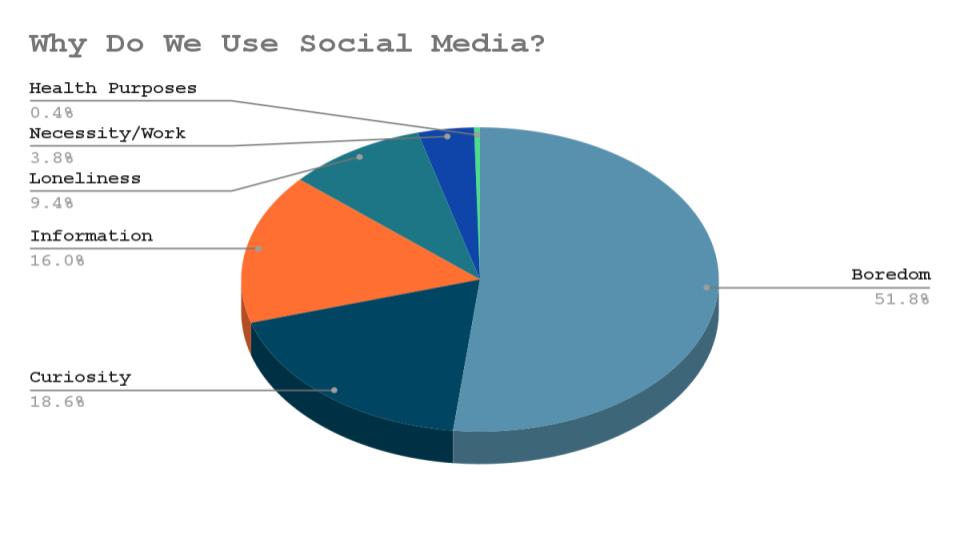
According to SimpleTexting (2021), boredom is the main reason people use social media apps. More than half (51.8%) of us use it to pass the time. I’m always on my phone whenever there’s nothing going on. It’s a nice distraction to keep myself busy for the moment. (Or so I thought.) There are other notable reasons why people use social media as well.
The Journey to Salvation
For my digital detox project, I stopped using social media for five days. This included Instagram and LinkedIn. It wasn’t too complicated. I started my digital detox years ago when I deleted all my other social media accounts. It was needed to get my life back on track.
My schedule is pretty jam-packed this semester. I’m taking seven courses including an internship and a part-time job on the weekend. There’s always something for me to do. Time management will be crucial in order to survive the next four months.
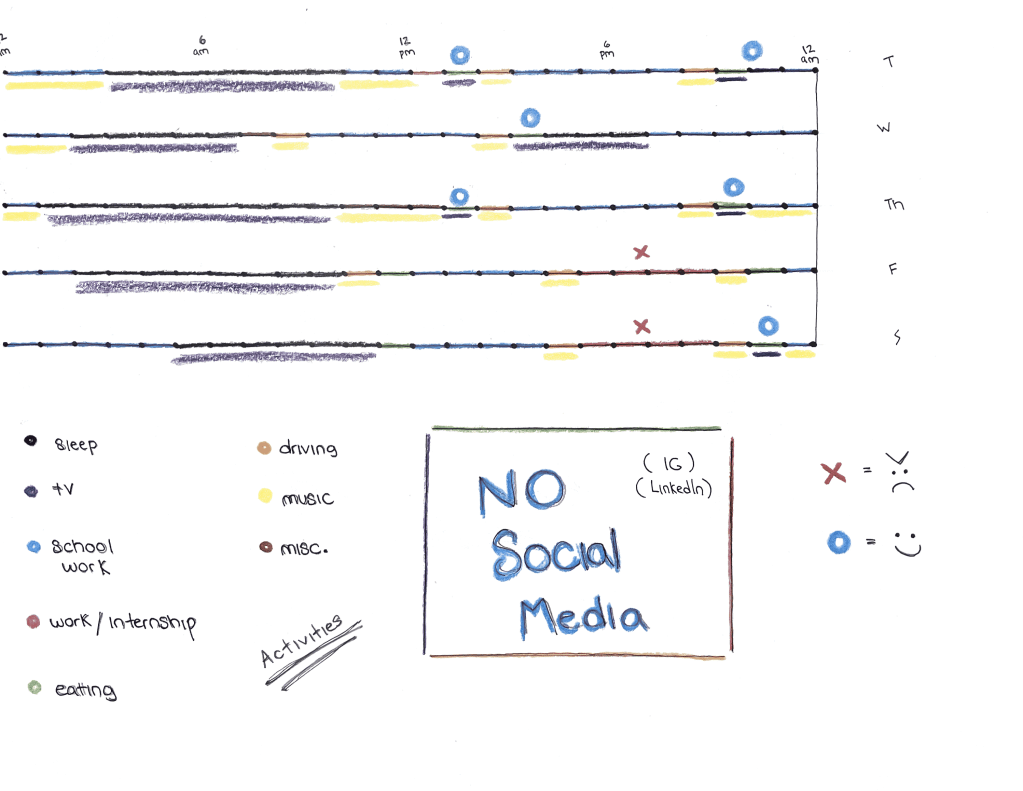
I noticed that I usually get 4-5 hours to myself that doesn’t involve school, work or sleep. There’s little time for friends or social events until my schedule starts to lighten up.
The chart shows that I’m “happy” whenever I have the opportunity to eat and watch TV. This is the only time that I get to relax throughout the day. Unsurprisingly, I’m “unhappy” when working at my part-time job. It was interesting to see the amount of time I spent listening to music this week. I usually don’t do it a lot.
In conclusion, this experiment allowed me to analyze my weekly schedule. I never realized how similar my days looked until now; every day felt spontaneous. (I guess we all follow a strict schedule.) Overall, it was a nice break from social media. I did feel a slight disconnection from the world, but I was able to focus more on my weekly objectives.
Howarth, Josh. “Time Spent Using Smartphones (2022 Statistics).” Exploding Topics, 27 May 2022, https://explodingtopics.com/blog/smartphone-usage-stats
Wilkinson, Drew. “Screen Time Trends in The Age of COVID-19.” SimpleTexting, 8 June 2021, https://simpletexting.com/blog/screen-time-survey/
 KREATIVV INC